Showing posts with label garden plans & design. Show all posts

Tuesday, 12 May 2015

2015-06-12: Permaculture Design: An Approach To Vibrant Communities

Permaculture and vibrant communities - another chance to make the connections - free!  See below:

Urban Systems is kicking off the third year of the Vibrant Communities Speaker Series with Takota Coen.  Check out the website for more information on the VCSS and past events!

When: Tuesday, June 2 from 7:00pm-8:30pm (doors at 6:30pm)
Where: Yellowhead Brewery, 10229 105 Street
This is a Free Event but please RSVP

Clean water, nutrient dense food, shelter and medicine are the building blocks for vibrant community no matter where you live on planet earth. However, most of the ways we supply our basic needs come at the cost of someone else’s or the earth itself.

In this thought provoking evening with Takota Coen of Deep Roots Design and Grass Roots Family Farm we will explore how permaculture design can address our fundamental needs in a way that is regenerative for the planet. Takota will provide practical examples of how families everywhere can use the principles and design methodologies of permaculture to ensure productive backyards and farms that strengthen our local food systems and restore the environment.

Using Grass Roots Family Farm as a case study, Takota will illustrate how to design functional relationships between various elements like forest gardens, chickens, annual crops, honeybees and even elements that would only be seen on larger acreages like a dairy cow, pasture pigs, beef cattle and water harvesting earthworks. This edition of the Vibrant Communities Speaker Series will also explore our Western society’s relationship to the natural world and how Takota believes it can be transformed through the ethical use of permaculture design, education, food, and celebration. Vibrant communities can exist. But only if we design them to succeed!

RSVP (through Eventbrite)

Monday, 20 April 2015

Plant More Flowers!

Plant more flowers for happy bees!

Which kinds?  Bees rely on a continuous supply of flowering plants for pollen and nectar.  Look at your garden and plan for continuous blooms -- this strategy makes your garden look great and benefits the bees!

Check out these sites for some plant ideas:
  • 30 Flowers in a Bee Friendly Garden - Plant list (garden flowers and fruit producing) with some photos, general growing instructions (sun/shade, water requirement), and other tips on how to make a garden bee-friendly.
  • Wikipedia's Pollen Source - Tables by season, for trees & shrubs, and flowers, herbs, and grasses with bloom time (month ranges for USDA zone 5) 
by amyisla
http://1000drawings.tumblr.com/post/111038695721/by-amyisla

Saturday, 11 April 2015

Dustin Bajer: Permaculture Connections

As Dustin Bajer addressed the group gathered at Bellevue Hall Wednesday, it was obvious he loved to teach and he was teaching something he loved.  The audience was engaged with his enthusiasm and energy, and it became very apparent his "rock bed" childhood in Barrhead was a very fitting beginning for a permaculture designer (and teacher, and beekeeping hobbyist...), for a rock is not "just a rock"

"What is permaculture? A hundred permaculturists in a room will have a hundred definitions -- and none of them would be wrong..." 
He addressed the fact that permaculture is more widely heard of now, but most people do not know what it means.  He spoke of his definition, (which included mimicking patterns of nature in design, looking at relationships and connections), and related principles (including caring for the land and returning things back to the system).  

Pictures of complex systems filled the screen, and he spoke of their web-like nature (Muir's Web) and how interconnected an organism (or element) can be.  Ultimately illustrating an organism is "better off together in a community than on its own" because even if one connection is broken, there are others supporting it.

The hour quickly ended and bled into the next.  Dustin shared photos of transforming his yard into a sustainable and highly productive garden (along with putting the image of him as a "lettuce fairy" into our minds), while also answering a great number of questions ranging from bee keeping to the garden he's worked on with Jasper High School students in their courtyard.

It was certainly a fun and educational night.

For those who missed out on the talk, below are some notes I made of the night.  For those who attended, what did I miss?  What was your greatest take away?

Thank you again Dustin for coming to speak with us -- we look forward to seeing you again soon!

Dustin Bajer with Highlands Garden Club members.
Resources mentioned and recommendations made:
- Fungi.com for Fungi for Healthy Gardens - Used to treat roots of plants or growth medium (straw / compost)
- Mushrooms of Western Canada - Lone Pine Publishing - Mushroom identification
- Rainwater Harvesting for Drylands and Beyond by Brad Lancaster - Create water cycle, use water more effectively
- Sustainable Food Edmonton - many resources (previously Community Garden Network)

Permaculture boils down to connections and relationships: 
- Care for the land and return to the system
- Meaningful connections - symbiotic relationships:
   - e.g. "Red Cap" mushrooms and popular tree - mushroom is more efficient at gathering water and helps the popular tree, which in turn feeds the mushroom by providing leaves and sugar sap
   - The link between bees and mushrooms (Paul Stamets)

* Better off together in a community than on its own

1. Connections make things more stable
2. More diversity is more manageable
3. More connections, the more sustainable.

"Great leaders align strengths so their weakness don't matter." ~ Peter Drucker (management guru)
- Ecological systems do the same 
- Muir web: A rock does "nothing" - but actually: provides a place to live on, live under, is a thermal mass that absorbs heat during the day and releases it in the night, buffers temperatures creating a micro-climate around it, will eventually erode and breakdown into the soil --> A side walk, a house is like a giant rock

Cycles are created in these systems 
- A forest during a drought looks better than a regular urban garden because of the cycles that are contained in the system (e.g. water remains in the system)
- If everything is cycled (more reused) we have multiple times more resources
- Parallel in economics: Cities are places that maximize connections

- Vegetables from garden 
- Aquaponics to raise fish - which water is then used as garden fertilizer 
- Fish and vegetables used in culinary / home ec. courses

What about weeds?
- "You get the weeds your soil needs"
- Dandelions - if you wait long ehntough they'll actually imporve the sol so other things can grow there (tap roots goes through compacted soil, leaves organic matter)
Loose soil: chickweed

"YOUR GARDEN WANTS TO BE A FOREST!"
- Graph: Energy x Time
- Stored energy is high in a forest and low in a typical urban garden
- Energy to maintain is high in a typical urban garden and low in forest

Implementing a garden with permaculture principles in mind - (move closer to forest):
- Plant your water, before planting your garden
- Weeds are basically fast growing annuals - combat them by planting the same thing (e.g. lettuce) everywhere
- Weeping tile (with a stocking) to bring water directly from roofs into the garden
- No till gardening: a layer of leaves or straw, a layer of compost, then plant directly into compost
- Rhubarb under fruit trees - leaves and stems funnel water to the base of the tree

"City honey is the best honey...."
- Layers are a cross-section of the seasons (Mayday , lilacs, dandelion, apples...)


Monday, 16 March 2015

Groundbreaking!

Niki Jabour's Groundbreaking Food Gardens: 73 Plans That Will Change the Way You Grow Your Garden, is available at EPL! 

The GardenDesign.com featured book is made up of 73 different edible garden plans -- each designed by a different garden writer / blogger / horticulturalist /... The collection covers a wide array of situations, interests, and themes (E.g. Chickens! Balcony only! The entire front yard! A biodynamic farm! Go Elizabethean!").

Each plan is introduced by Jabbour with information about the designer, background on the theme, and great gardening tips to complement.  Charming illustrations (3 different illustrators) give each plan life. 

Though plant lists are included, Jabbour's introduction stresses "grow what you like to eat" and that designers offered the lists only as suggestions (to be replace freely with things that fit your region, climate, and personal tastes).


Overall: A great jumping point to finding your next favourite garden writer / blogger / designer / ... This book is a sampler: packed full of inspiring ideas and information from general to niche, but as a result not everything is applicable.  I will definitely be coming back to this book because even plans not obviously achievable for a urban Edmonton home are still educational (design and ecology) fun reads.

Pros:
  • Jabbour has done all the work in tracking down the best people to submit a garden design.  
  • Plan design principles and complementary gardening methods are included making the book educational -- more than just a "plant this here" map
  • Some powerhouse food producing plans and some more focused on style -- most fall in between
  • Adaptable, environmentally-conscious plans to fit many situations
Cons / Limitations:
  • The plans are fairly flexible, but does seem to be geared towards mid-range climates.   Edmontonians and other northerners will have to work harder to adapt the plans
  • Can be overwhelming as plans are not obviously grouped in anyway 
  • No photographs - which would be particularly helpful for some of the more abstract plans

Bee-Friendly: Working with nature is highly stressed in many of the plans and Jabbour uses organic methods.  Plans particularly focused on this include "Backyard Beekeepers' Garden" by Kenny Points, "Pollinator-Friendly Raised Bed" by Paul Zammit, "Wildlife-Friendly Garden" by Tammi Hartung, "Good Bug Garden" by Jessica Walliser

Thursday, 12 February 2015

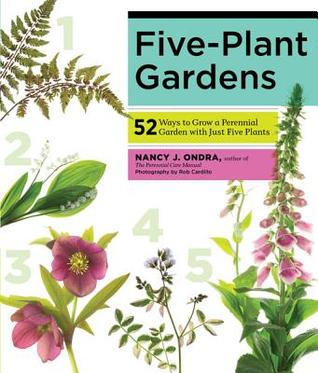
Five-Plant Gardens -- Perennial Garden Design (by the book)

Nancy J. Ondra's 2014 book, "Five-Plant Gardens: 52 Ways to Grow a Perennial Garden with Just Five Plants", promises easy gardening using just five perennial plants.

Pretty plants that come back year after year?  Sign me up!  But, can it really be that easy?

Ondra advises to start small ("Admire large gardens but plant small ones"), shop smart (begin with 5" pots- plants will grow and spread), and get in the zone (USDA Plant Hardiness).  Her enthusiastic writing is energising and everything is kept simple.  The "five plants", however, refers to five types of plants -- sometimes more than one of each kind is required.

Overall thoughts:
This is a well thought out and very pretty book.  It hits the right notes with me, a beginner gardener - providing lots of information, sensible advice, and inspiration for more.  The "first choice" plants include zone 3 (good for Edmonton) and plenty of advice on how to substitute for those that aren't.  The plant photos are particular favourites - especially those in seed in the "For the Birds" and "Winter Wonderful" gardens. Best of all, it's available at EPL!

The book is divided into two main parts: "Five-Plant Gardens for Full Sun to Partial Shade and "Five-Plant Gardens for Partial to Full Shade".  (See * for additional info on the book's structure.)

Pros:
  • Simple designs can be tiled and combined to expand your garden over time or to fit around structures (such as a porch or pathways) 
  • Gardens are themed: colours, bloom time, attracting / deterring wildlife, usage (e.g. cuttings, scent)
  • Includes plant alternates (named and general e.g. "Another 6- to 12-inch-tall perennial with white flowers, such as wall rock cress..."), so you can substitute as needed and still keep the original garden's look 
  • Includes a "Season by Season" summary and "Digging Deeper" section for each garden with what to expect, how to care for plants, and how to use the garden
Cons:
  • Nothing bad, just some limitations: Plant care in the long run not addressed ("Many perennials can live for 3 to 5 years with hardly any attention..." what afterwards?), is a "plant-by-numbers guide" doesn't teach principles of design.  
  • Table of Contents lists garden names without specific page numbers
Bee-Friendly:

The book doesn't have a Bee-Friendly focus, but does indirectly incorporate some bee-friendly features:
  • Uses bee-friendly plants (full of pollen and nectar, or native) e.g. Echinacea purpurea (coneflower), Monarda (bee balm), rudbeckia (Black-eyed Susan), sedum,  and gives enough information for you to substitute your choice of bee-friendly plants
  • Multiple plants of the same kind are grouped together - xerces.org advises planting the same flower in clumps to attract bees.  This could be because bees harvest from one type of flower at a time and locate flowers using sight -- mass plantings are easier to see find and would allow for maximum food collection on each trip.
-------------------------------------------------------------------------
* Each garden includes:
- A planting plan
- A moisture requirement scale (Dry, Average, Moist)
- A pretty illustration of the garden
- Photographs of the plants on a plain background
- A shopping list for plants (with suitable alternatives)
- A "Season by Season" summary on what to expect in the garden and how to care for the plants
- A "Digging Deeper" section ideas and suggestions (such as how to incorporate annuals into the specific plan or where it might be especially suitable)

Friday, 30 January 2015

Veggie Patch Friends - Companion Planting

Planning your vegetable garden and have some extra space?  Why not throw in some comos?  What I'm suggesting (aside from growing some pretty flowers) is a very basic form of companion planting: 'planting of different crops in proximity for pest control, pollination, providing habitat for beneficial creatures, maximizing use of space, and to otherwise increase crop productivity'.

Just as you may have been told to grow basil with your tomatoes for them to grow better, or marigolds to repel pests...  These are not old wives' tales, studies have confirmed both and many other productive plant pairings.

Anglianhome.co.uk's "A Vegetable Growing Cheat Sheet" (portion on  the right, go to link for full chart) makes the whole thing very simple. But is limited to the most common / popular vegetables in the UK.

Wikipedia's List of Companion Plants not only lists those that help, but also those that might harm the yield of certain vegetables and fruit trees (e.g. beets and bush beans don't get along).  Reading the entire list and trying to incorporate everything, however, is a little like planning a wedding seating chart for friends, feuding family members, and fawning couples (with some history of the relationships)... But if one can get similar results as 20% more tomatoes when grown with basil with other vegetables, it seems worth it to doing a little investigating.

AfriStar Foundations "Companion Plantings" (below) is a great balance of the two - not too detailed, not too simplified.  The names of the plants might be a little different from what we're used to, but there are pictures to help.

Oh, and what of those cosmos I mentioned before?  They're everyone's good companion: they attract beneficial insects (bees and pest predators).

For more information about different plant pairings not just for the vegetable garden also see Organic Gardening's Beginner's Guide to Companion Planting.


Bee-Friendly: Companion planting encourages not using pesticides, instead working with nature by attracting beneficial bugs, repelling pests, or luring pests away.


Monday, 26 January 2015

Plan to Garden - Garden Planning eTools

Got garden planning fever?  A bout hit me while online, so instead of my usual garden planning MO (grabbing a random piece of paper and pen, doodling, and inevitably misplacing it), I decided to give two free online garden planning tools a try.

Garden Planner 3 


Start creating your own birds-eye-view garden plan or open up one of four sample plans and start editing.  The online demo version allows for printing, but not saving.  A 15 day free trial of version 3.2 is available and for $ 34 you can own the program. 

My backyard (approximately) in Garden Planner 3
Pros:
  •  A number of generic items you would find in a garden (such as flowers, trees, furniture, planters) are programmed in
  • It's easy to change the colour and size of these items once you've added them in
  • You can draw your own items using the "tools" tab and label accordingly

Cons:
  • You need to click a button to switch between "moving" or "resizing" an object
  • When resizing, instead of one edge changing, the object increases or decreases with the middle point staying static
  • Windows keyboard short cuts (e.g. Ctrl-C to copy) do not work.
  • Online demo (free) cannot save

Overall thoughts:
Fun to play with, but not very user-friendly.  Other reviewers of the free demo have called it no better than moving around paper cutouts.


Better Homes and Gardens' Plan-A-Garden


Create a free account with Better Homes and Gardens (www.bhg.com) to start dragging and dropping plants and garden elements onto one of 27 "scenery" backgrounds.  Upgrade with a $ 9.99 subscription or purchase the program license to "unlock" plants and items or to upload your own photo as a background.

My front yard (approximately) with horizontal plan view in BHG's Plan-A-Garden

Pros:
  • Plant information is included: You can filter by shade and light requirements and clicking on the object's information button will take you to the BHG's plant encyclopedia
  • Realistic looking plants and objects 
  • Search available for objects
  • The main view let's you view the plan vertically, while the "Plan View" allows you to to see and edit the horizontal layout

Cons:
  • Undo button undoes all changes until last save
  • No drawing abilities - limited to item lists (which do not include annuals or some of the most common plants in Edmonton e.g. peonies, mountain ash trees)
  • Can increase or decrease the size of items, but not change its proportions or colours
  • Print function is of main view and includes no notes on plants used

Overall thoughts:
Moderately fun to play with, but lacks functionality and practicality. The pretty plants and objects are quickly overshadowed by the limited selection and inability to "create your own" stand-ins. 


Final Notes 

Again, while fun to play with, neither program really delivered what I needed.  One gets what one pays for!  Of the two, based on the features shown in the free version, I'd more likely buy Garden Planner 3 for it's flexibility and then search online for plant information.  But, I think at the moment I'm just as good to invest in a dedicated garden planning note book for my doodles and some coloured paper to make cutouts.  

Have you tried other online Garden Planning Tools?  Have you found one worth the cost?  What's your favourite way to plan a garden?