Showing posts with label Bee-Friendly. Show all posts

Sunday, 30 April 2017

Building Bee Hotels

Club member Bob opened up his workshop this past Saturday for the club to make bee hotels.

Armed with wood from an old project, and advice and blue print plans from Hal Hopkins, members went to town with the power tools!

Everyone had a great time. When the storm clouds did start to roll in, the builders moved the party into the garage for Rickie's lemon squares and tea and coffee.

It was hard work, but overall a lovely afternoon.

Photos by Erica.

(Above right: A finished bee hotel -- ready for local native bees to check-in!)


(Below: Garden Club builders hard at work.)


Tuesday, 12 July 2016

Neonics in the News: Lawsuit Launched!

Ecojustice* has launched a lawsuit to challenge the federal permits given to two neonic pesticides!

This class of pesticides has been linked to mass die-off of bees and is controversially still available in Canada. According to the lawyer for Ecojustice, Charles Hatt, "The (Pest Management Regulatory Agency) does not have reasonable certainty about the risks of these products, which they're required to do."

For more on the background of these permits and other related articles visit CBC News's post.

* Representing The David Suzuki Foundation, Friends of the Earth Canada, Ontario Nature and the Western Canada Wilderness Committee

Monday, 20 June 2016

Celebrate Pollinator Week 2016

It's National (US) Pollinator Week!

Celebrate by learning about and appreciating our pollinator friends (bees being only just one) between June 20-26, and spread the news.

Visit:


Tuesday, 29 March 2016

Hal Hopkins: Building Bee Hotels

Join Highlands Garden Club in its commitment to helping our community protect pollinators and “Bee Friendly”. This is very important because native bees ensure the growth of the food we eat as well as the flowers we enjoy. To do this job they need food, protection from pesticides and shelter. We can all help by planting native heirloom plants, avoiding the use of pesticides and:

Building Bee Hotels

Highlands Garden Club invites you to hear guest speaker Hal Hopkins, a man who is avidly involved in studying native bees.

Date and time: Wednesday, April 13 at 7:00 pm
Location: Highlands Community League, 6112 – 113 Avenue
Admission: FREE or Bring seeds to share with your neighbors

Hal has set up and monitored bee hotels at the University of Alberta Farm and has collaborated with the Edmonton & Area Land Trust on bee hotels. He shared information in an article on bee hotels in the Fall 2015 issue of Alberta Nature magazine. Hal will now share with us his experiences on what the bees prefer and what they don’t like.

Note: Bee hotels are built for solitary bees which do not sting.

Thursday, 20 August 2015

‘Bee hotels’ give solitary pollinators rooms of their own

Excerpt from the article Margaret shared at the August meeting (click on the link to see full article and video):


‘Bee hotels’ give solitary pollinators rooms of their own
Madeleine Cummings, Edmonton Journal 07.19.2015
The “hotel,” which was attached Monday to a tree on the Edmonton Community Foundation’s downtown grounds, is made of wood and hollow bamboo stems. It has about 200 cylindrical holes, where solitary bees can lay eggs.

Unlike honey bees, which live communally in hives, solitary bees live alone, but still need safe spots to stash their eggs. Normally, bees find sheltered nooks and crannies in trees or underground, but these have become scarce in Edmonton and other cities across the country.

Thursday, 14 May 2015

Protect the Pollinators Tour - Notes and Petitions

Back on 24-March, member Audrey braved the snow to attend the Protect the Pollinators talk hosted by the Sierra Club Canada Foundation at Kings College. 

http://teesforthepeople.com/products/protect-the-pollinators
There she found from Pesticide-Free Edmonton that Edmonton is still using Dursban 2.5 G -- a neuro-toxin pesticide which Winnipeg has banned -- for killing mosquitoes.

The Edmonton Journal has reported on this outlining concerns in this April-2015 article

Click here to sign the online petition to the City of Edmonton to Discontinue the use of Dursban and all other forms of chlorpyrifos for killing mosquitoes.


The talk also featured John Bennett (National Program Director of the Sierra Club Canada Foundation), and Paul McKay (author of The Kepler Code), speaking on the threat of neonics and the importance of healthy pollinator populations.

Click here to download the handout "Five Reasons We Support Restrictions on Neonics".

Click here to send a message to the federal and provincial governments to ban the use of neonics (via the David Suzuki Foundation).

Monday, 4 May 2015

Highlights: Think "Bee Friendly"

The Highlands Garden Club is again in the Highlights Community Magazine.  The May-2015 edition hit post boxes this past weekend, including with it the Club's message to ask before buying plants (Are they bee friendly?), along with educating readers about neonicotinnoids (neonics) pesticides. 

Help spread the word!  Pass along, Deb's article and Think "Bee Friendly"

Additional resources:
------------------------------------------------------------------------------------------------------

Think "Bee Friendly"

Debbie Petit, Highlands Garden Club

The Highlands Garden Club was formed in 1989.  Some members have had a garden for many years and some are new at it.  We have all have a love for perennials.  These are the purest and most trustworthy plant.  We know there is nothing in these plants to harm our bees, but the same can't be said for annuals. 

The club's theme this year is "Bee Friendly."  We have been gathering information on neonicotinoids (neonics), a bee-killing insecticides that has been linked to the global decline of bee populations.  Neonics are grown in the plant from seed, and cannot be washed off.  Neonics cause bees to become confused and unable to communicate; they die an awful death.

Now that it's May, please pay attention to what you feed the bees.  There is nasty stuff in those pretty annuals you buy at the big box stores.  Ask questions.  If staff do no know if a plant is bee friendly, go to your local greenhouse.  It makes sense to buy from a greenhouse, rather than somewhere you can buy lumber, tires, or clothing.  

The Highlands Garden Club met with Rob Sproule from Salisbury Greenhouse, he says if you must use a pesticide do not spray when trees and shrubs are in bloom.  If some bugs become too much a pest, be patient.  Predators will come.  Also, while many see dandelions as a nuisance, they are very important as they are the first flower of the season for bees to feast upon. 

Monday, 20 April 2015

Plant More Flowers!

Plant more flowers for happy bees!

Which kinds?  Bees rely on a continuous supply of flowering plants for pollen and nectar.  Look at your garden and plan for continuous blooms -- this strategy makes your garden look great and benefits the bees!

Check out these sites for some plant ideas:
  • 30 Flowers in a Bee Friendly Garden - Plant list (garden flowers and fruit producing) with some photos, general growing instructions (sun/shade, water requirement), and other tips on how to make a garden bee-friendly.
  • Wikipedia's Pollen Source - Tables by season, for trees & shrubs, and flowers, herbs, and grasses with bloom time (month ranges for USDA zone 5) 
by amyisla
http://1000drawings.tumblr.com/post/111038695721/by-amyisla

Thursday, 5 March 2015

Neonics in the News: 97% in Ontario Support Restrictions

Great news! 

"Ontario's proposal to restrict bee-killing pesticides received an overwhelmingly positive response from the public. Close to 50,000 comments were submitted during the official consultation on Ontario's pollinator health proposal last month. Approximately 97 per cent favoured government action to restrict the use and sale of neonicotinoid pesticides."  

They are now in the second consultation phase.  Complete article here


Continue the good work by visiting DavidSuzuki.org to send a message to provincial and federal ministers for Canada to ban neonics. 

Get both Canada and the provinces on board because they have different regulatory powers regarding pesticides and their use - read more about this here

Thursday, 12 February 2015

Five-Plant Gardens -- Perennial Garden Design (by the book)

Nancy J. Ondra's 2014 book, "Five-Plant Gardens: 52 Ways to Grow a Perennial Garden with Just Five Plants", promises easy gardening using just five perennial plants.

Pretty plants that come back year after year?  Sign me up!  But, can it really be that easy?
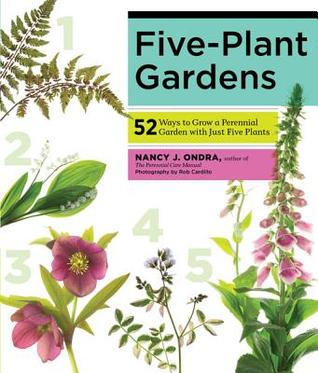
Ondra advises to start small ("Admire large gardens but plant small ones"), shop smart (begin with 5" pots- plants will grow and spread), and get in the zone (USDA Plant Hardiness).  Her enthusiastic writing is energising and everything is kept simple.  The "five plants", however, refers to five types of plants -- sometimes more than one of each kind is required.

Overall thoughts:
This is a well thought out and very pretty book.  It hits the right notes with me, a beginner gardener - providing lots of information, sensible advice, and inspiration for more.  The "first choice" plants include zone 3 (good for Edmonton) and plenty of advice on how to substitute for those that aren't.  The plant photos are particular favourites - especially those in seed in the "For the Birds" and "Winter Wonderful" gardens. Best of all, it's available at EPL!

The book is divided into two main parts: "Five-Plant Gardens for Full Sun to Partial Shade and "Five-Plant Gardens for Partial to Full Shade".  (See * for additional info on the book's structure.)

Pros:
  • Simple designs can be tiled and combined to expand your garden over time or to fit around structures (such as a porch or pathways) 
  • Gardens are themed: colours, bloom time, attracting / deterring wildlife, usage (e.g. cuttings, scent)
  • Includes plant alternates (named and general e.g. "Another 6- to 12-inch-tall perennial with white flowers, such as wall rock cress..."), so you can substitute as needed and still keep the original garden's look 
  • Includes a "Season by Season" summary and "Digging Deeper" section for each garden with what to expect, how to care for plants, and how to use the garden
Cons:
  • Nothing bad, just some limitations: Plant care in the long run not addressed ("Many perennials can live for 3 to 5 years with hardly any attention..." what afterwards?), is a "plant-by-numbers guide" doesn't teach principles of design.  
  • Table of Contents lists garden names without specific page numbers
Bee-Friendly:

The book doesn't have a Bee-Friendly focus, but does indirectly incorporate some bee-friendly features:
  • Uses bee-friendly plants (full of pollen and nectar, or native) e.g. Echinacea purpurea (coneflower), Monarda (bee balm), rudbeckia (Black-eyed Susan), sedum,  and gives enough information for you to substitute your choice of bee-friendly plants
  • Multiple plants of the same kind are grouped together - xerces.org advises planting the same flower in clumps to attract bees.  This could be because bees harvest from one type of flower at a time and locate flowers using sight -- mass plantings are easier to see find and would allow for maximum food collection on each trip.
-------------------------------------------------------------------------
* Each garden includes:
- A planting plan
- A moisture requirement scale (Dry, Average, Moist)
- A pretty illustration of the garden
- Photographs of the plants on a plain background
- A shopping list for plants (with suitable alternatives)
- A "Season by Season" summary on what to expect in the garden and how to care for the plants
- A "Digging Deeper" section ideas and suggestions (such as how to incorporate annuals into the specific plan or where it might be especially suitable)
Monday, 9 February 2015

Talk & Tour: Rob Sproule at Salisbury Greenhouse

Kicking off this year of Bee-Friendly learning and gardening events, we're heading out to Salisbury Greenhouse!

Rob Sproule* will be talking about bee-friendly plants, bee-friendly gardens, and pest management at the greenhouse, while giving us a tour the facilities.  

Interested in joining us?  Meet Sunday, 15-February-2015 at 1 p.m. (1 km south of Wye Road on RR 232 (Brentwood Blvd)) for the Talk & Tour, or contact us at highlandsgardenclub@gmail.com to arrange carpooling.  
---------------------------------------------------------------------
* The gardener, writer, and Edmonton Journal columnist introduced many to the problem of neonics and the plight of the bee in his 04-June-2014 Edmonton Journal article Making a safe place for the bees.

Monday, 2 February 2015

Clean Start: Organic Seeds

While browsing seeds at the store and in catalogues have you been looking for organic* seeds?
With the organic gardening and farming movement gaining popularity, organic seeds are starting to show up in the stores, albeit in small numbers and limited types (usually herbs).

In contrast, local retail source, Apache Seeds, stocks many organic and heirloom varieties seed lines, and their selection is currently at it's highest.

Earth's General Store, doesn't have their organic seeds yet (as of 02-Feb-2015), but should by March. (Other organic and sustainable gardening tools, however, are available.)

Does your favourite seed company have organic varieties?  How do you get them? 

----------------------------------------------------------------------------------------------

* Organic Certification doesn't mean "pesticide-free", but does mean no synthetic pesticides have been used.  Neonics are synthetic systemic pesticides, so seeds from plants that have been treated with neonics cannot be certified organic.

Organic pesticides are generally not systemic: Penn State University has listed "none have systemic activity" as being a limitation of organic pesticides and Oregon State University's "Profiles of Natural Pesticides" only lists one (Azadirachtin, a Neem derivative, as being systemic at root, and mildly systemic in leaves).  This is a good thing for our Bee-Friendly goals: even if the parent plants were treated with the organic pesticide, it would not have persisted to the seeds and next generation of plants. 

Friday, 30 January 2015

Veggie Patch Friends - Companion Planting

Planning your vegetable garden and have some extra space?  Why not throw in some comos?  What I'm suggesting (aside from growing some pretty flowers) is a very basic form of companion planting: 'planting of different crops in proximity for pest control, pollination, providing habitat for beneficial creatures, maximizing use of space, and to otherwise increase crop productivity'.

Just as you may have been told to grow basil with your tomatoes for them to grow better, or marigolds to repel pests...  These are not old wives' tales, studies have confirmed both and many other productive plant pairings.

Anglianhome.co.uk's "A Vegetable Growing Cheat Sheet" (portion on  the right, go to link for full chart) makes the whole thing very simple. But is limited to the most common / popular vegetables in the UK.

Wikipedia's List of Companion Plants not only lists those that help, but also those that might harm the yield of certain vegetables and fruit trees (e.g. beets and bush beans don't get along).  Reading the entire list and trying to incorporate everything, however, is a little like planning a wedding seating chart for friends, feuding family members, and fawning couples (with some history of the relationships)... But if one can get similar results as 20% more tomatoes when grown with basil with other vegetables, it seems worth it to doing a little investigating.

AfriStar Foundations "Companion Plantings" (below) is a great balance of the two - not too detailed, not too simplified.  The names of the plants might be a little different from what we're used to, but there are pictures to help.

Oh, and what of those cosmos I mentioned before?  They're everyone's good companion: they attract beneficial insects (bees and pest predators).

For more information about different plant pairings not just for the vegetable garden also see Organic Gardening's Beginner's Guide to Companion Planting.


Bee-Friendly: Companion planting encourages not using pesticides, instead working with nature by attracting beneficial bugs, repelling pests, or luring pests away.


Friday, 23 January 2015

Why Bee-Friendly?

For almost a decade, honeybee disappearance has been big in the news.  When Colony Collapse disorder (CCD) hits, honeybee hives are basically ghost towns.  And it rightfully has farmers scared: Much of our food supply relies on honeybee pollination to be successful.  Native bees have been called into action to help pollinate, but their numbers have been declining too. 

You're likely not a farmer and you might not even like honey.  But in the short and long term, taking care of our bees means taking care of you and your family. 

 The Short (Term) of It

1. Honey comes from honeybees
2. You eat vegetables, fruits, nuts, berries (or animals that eat those things) - Many of these require pollination to fruit or seed
3. You grow vegetables, fruits, nuts, or berries - Zucchini, pumpkin, watermelon need pollination to fruit and you get much better yields when raspberries, cherries, plums, blueberries, and apples are pollinated (imagine hand pollinating all those yourself!)

The Long (Term) 

1. Things (i.e. pesticides) that harm bees have been linked to harming birds
2. Things (i.e. pesticides) that can harm birds can harm pets and people (it's often just a matter of dosage)

(Warning: Mixed Metaphors ahead)

Take bees as your canary in the coal mine: be friendly to bees to be friendly to yourself.

Wednesday, 21 January 2015

Ban Neonics: A Provincial and Federal Matter

Neonicotinoids (neonics), a bee-killing insecticide that has been linked to the global decline of bee populations, is not regulated in Canada.

Is change at hand?  The Government of Ontario's proposed to drastically reduce neonics use by 2017, but also faces large amounts of lobbying from industry. 

http://action2.davidsuzuki.org/ontariobees
The David Suzuki Foundation has started an online petition to encourage the Government of Ontario to move on with the proposal -- restrict (a first step to eventual bans of) neonics use. 

Sign the petition / send an email before 25-Jan-2015 and Bee Counted! 
--------------------------


The application and use of pesticides is a provincially legislated matter - but before pesticides can be used, they must be registered and approved at the federal level through the Pest Management Regulatory Agency (of Health Canada). 

http://action2.davidsuzuki.org/neonics
The David Suzuki Foundation's email petition to ban neonics use in Canada directs the message to the federal Minister of Health and related provincial MLAs (e.g. Minister of Environment).  Sign today to help save the bees! 
 

Wednesday, 14 January 2015

2015: Bee-Friendly

Tonight's meeting was a flurry of ideas as Club members discussed and planned this year's activities.

The main result?  A combined resolution to be Bee-Friendly!

Basically, we aim to learn about, spread the word, and take action (in and out of the garden) to protect and support bees. 

Why such a focus? These important pollinators have been dying in large numbers worldwide and Highlands is not immune: A large group of dead and dying bees was found in the neighbourhood this past summer. It is scary, sad, and angering, and so we're taking action.

We'll be chronicling our Bee-Friendly findings here along with our events and activities as details are finalised.

We're ambitious. We hope you are also excited to join us in this challenge.